

Affiliate Disclosure As a Plugin Boutique and Amazon Associate I earn from qualifying purchases. This post may contain affiliate links. For more details, refer to my Terms page.
Eventide Quadravox is not a new plugin, and that is part of why it is worth writing about. It first arrived in 2016, and Eventide even gave it away free for a spell in 2019, so plenty of producers already have it sitting unused in a folder somewhere. It is still on sale, still supported, and still one of the more interesting harmonisers you can run, especially if you make electronic music rather than the vocals and guitars most reviews focus on.
I came to it after using Eventide's H910 plugin for a while and wanting something with more voices and more programmable timing. Quadravox is a four-voice diatonic pitch shifter built on technology from Eventide's flagship H8000FW processor, and it carries the same pitch-shifting heritage as the classic Eventide Harmonizer hardware that has been a studio fixture since the 1970s. This review looks at it from a house and dance production angle, with a bit of honesty about where it falls short.
Jump to:
What is Eventide Quadravox?
Quadravox is a four-voice diatonic pitch shifter. In plain terms, you feed it audio, tell it a key and scale, and it generates up to four extra voices that stay in that key. Because the shifting is diatonic, each voice snaps to a note that belongs to the scale you chose, rather than a fixed number of semitones, so the harmonies stay musical as the source moves.
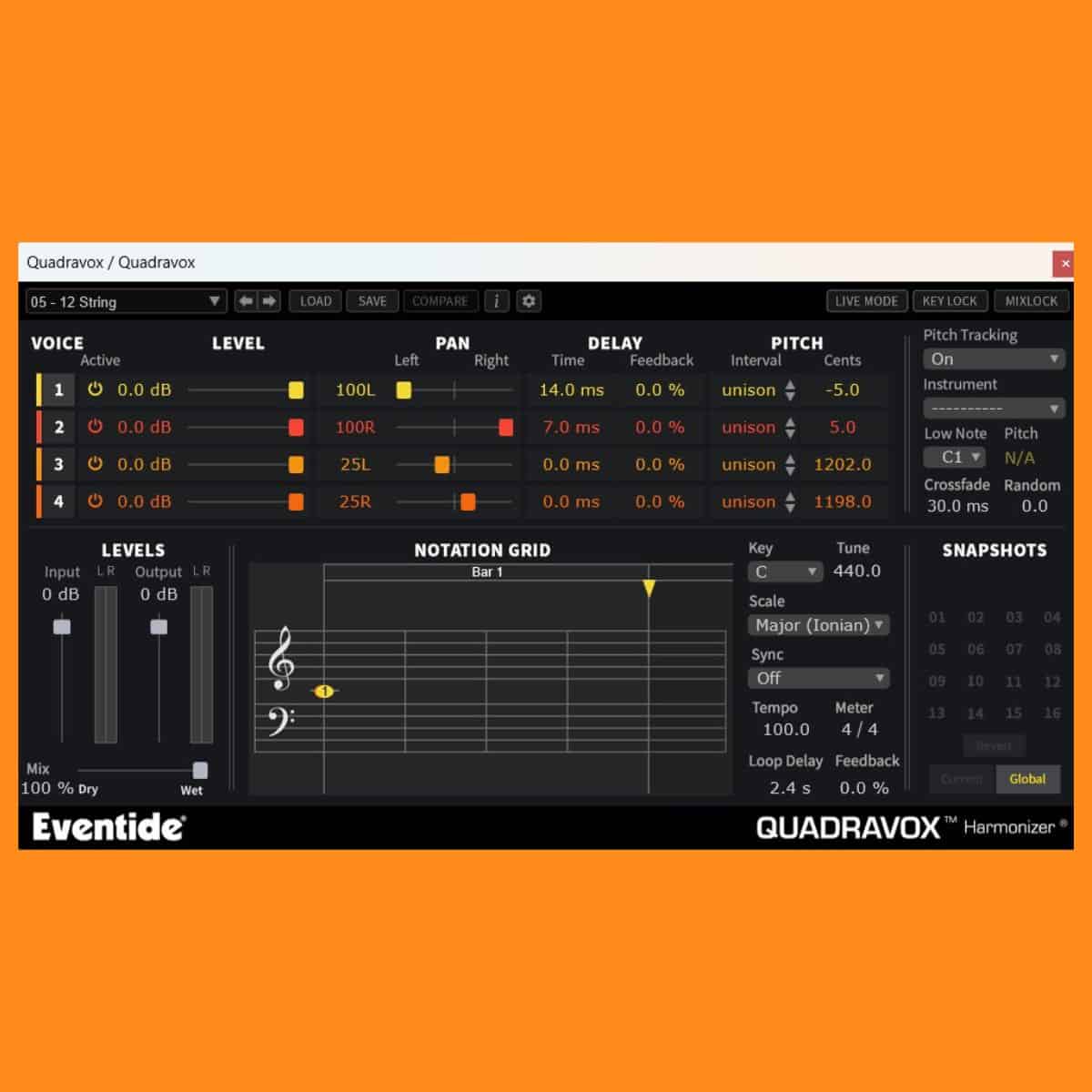
Each of the four voices has its own level, pan, delay with feedback, and pitch. You set all of that either with the sliders and typed values, or by dragging voices around the Notation Grid, which lays the pitches out on a musical stave with timing running left to right. Colour and brightness show pan and level at a glance. It is a genuinely quick way to work if you can read a stave, and it is the feature that separates Quadravox from a plain pitch-shift box.
This is a different job to something like Scaler 3. Scaler generates MIDI chords and progressions for you to play into an instrument. Quadravox does not touch MIDI notes at all. It harmonises the audio you already have, following the key and scale you set. The two can sit happily in the same project, but they are not doing the same thing.
How does Quadravox sound on synths and for dance music?
On synths it sounds clean and tight, and it turns single-note parts into stacked harmonies, panned sequences and tempo-locked grooves. Most Quadravox coverage centres on backing vocals and guitar, so this is the side that is less written about, and for dance music it is arguably the more useful one.
To test it I dropped a simple eight-bar poly synth loop into Bitwig at 140 BPM, a single-note part with nothing clever going on, and worked through the voices. With one voice active you get a straightforward harmony you can pan and time. Add a second and you can bring it in on the beat or offset it so it answers the first. Build up all four and you can stack cinematic harmonies or spread notes across the stereo field for width.
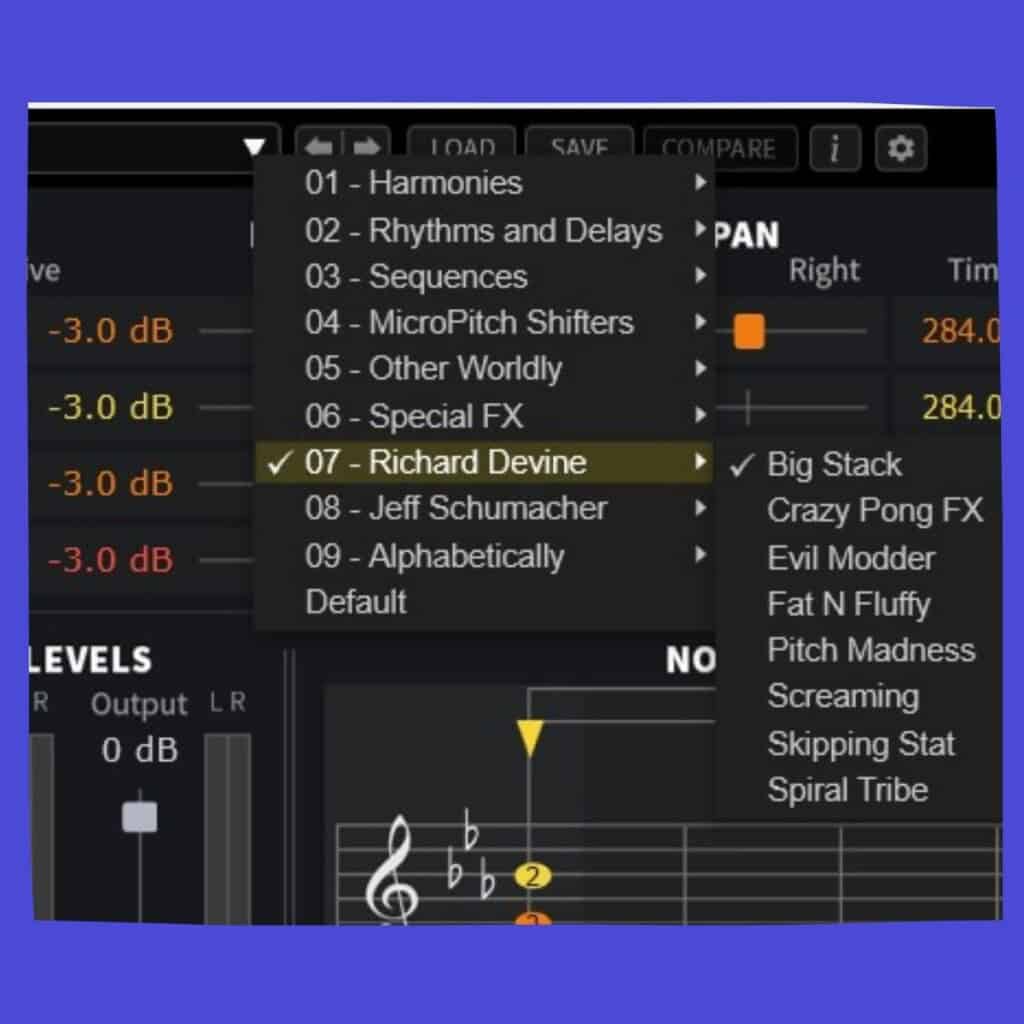
The preset banks are where the dance potential shows. The sequence presets are the standout. One of them sets voices one and three panned left, voices two and four panned right, with delays between them and a mix of fourths, fifths and an octave up. Play a plain riff through it and you get a moving, panned sequence that works well as the basis for a bassline or a lead hook. Because the per-voice delays sync to your session tempo, short times and small shifts thicken and widen a sound, while longer times and larger shifts build arpeggiated grooves.
One important setting: pitch tracking. With it on, Quadravox follows a single detected pitch, so it is happiest on monophonic sources. Turn pitch tracking off and it stops trying to read a note and treats the input as raw material, which is how you get it working on chords, drums and rhythmic parts. That switch is the difference between it fighting your source and it transforming it.
What features are worth knowing?
Beyond the four voices and the Notation Grid, a few things are easy to miss and worth your time:
Live Mode trims the default 40ms latency that Quadravox normally runs in. So with this mode on you can audition and perform in real time. The trade-off is quality, so the sensible workflow is to switch Live Mode on while you experiment, then switch it off when you commit to a sound for the cleanest result.
Does Quadravox handle MIDI and automation?
Set your expectations correctly here. Quadravox is an audio effect, not an instrument. You do not play MIDI notes into it to trigger harmonies. It follows the key and scale you set and tracks the pitch of the audio you send it. For anything you want to move over time, use your DAW's parameter automation. In Bitwig, for example, you can right-click a control such as delay, feedback, shift or loop and automate it from there. There is no interface-level MIDI learn, so your host is where that work happens.
What are the downsides?
For me I found that pitch tracking takes care on expressive vocal lines. It can occasionally misread a note and send a voice off in the wrong direction, and dialling that in properly is fiddly. Again, this is more of an issue on vocals than on steady synth or instrument parts.
Also, Quadravox is managed through iLok, which adds a setup step, and it is a specialised tool rather than an everyday utility. You will reach for it deliberately, not on every track. I'm not a fan of iLok as you'll know from my Substack rants, but I also understand why it's there.

Are there free alternatives to Quadravox?
If you want to test the water before buying, a few free harmonisers get you part of the way. None of them match the four-voice Notation Grid and tempo-synced delays, but they cover the basics.
- Pitchproof by Aegean Music is a free diatonic pitch shifter and harmoniser. It works well on monophonic sources such as vocals, guitar solos and single-note synth lines, and it has a guitar tuner built in. It does produce audible artefacts on polyphonic material, so keep it to one note at a time.
- Duet by Martin Eastwood Audio is a free Windows VST double-tracker and harmoniser, good for width, thickening and doubling on vocals and synths.
- Graillon 2 by Auburn Sounds is a freemium pitch correction and harmony tool. The free version gives you autotune-style correction plus a pitch-shift voice you can use for a simple harmony, with the full feature set behind a paid upgrade.
For more options in that vein, see the Audioblob free VST plugin list. If you would rather spend a little and get a lot, the 10 plugins under £30 roundup is a better starting point than most freebies.
If you go the other way and want more voices, Eventide's Octavox is the eight-voice version of the same engine, with more presets. Quadravox is the smaller, more affordable four-voice option.
Is Eventide Quadravox worth it?
For creative harmony and sequence work, yes. It is quick, musical and distinctly Eventide, and it earns its place on synths, riffs, guitar and rhythmic material with pitch tracking off. The Notation Grid and the tempo-synced delays make it a compositional tool as much as an effect, and it turns plain parts into something with movement. It also turns up cheaply in Eventide and Plugin Boutique sales fairly regularly.
Where it is less convincing is polished vocal harmony, purely because of the missing formant control. If clean, natural backing vocals are your main goal, budget for extra tidying or a different tool. If you want a harmoniser that inspires ideas and reshapes sounds, Quadravox still holds up well.
If you already like Eventide's approach to effects, it sits comfortably alongside something like Eventide Blackhole, and it pairs neatly with a dedicated vocal processor such as the one covered in the VoxGuru review when you do want to work on voices.
FAQ
Is Eventide Quadravox still worth it in 2026?
Yes for creative harmony and sequence work on synths, guitar and drums. It is a mature, supported plugin that often appears cheaply in Eventide and Plugin Boutique sales. For polished vocal stacks, the lack of formant control is the main caveat.
Can Quadravox process polyphonic sounds and drums?
Yes, switch pitch tracking off. With tracking on it follows a single detected pitch, so it is happiest on monophonic sources. Off, it treats the input as raw material, which suits chords, drums and rhythmic sequences.
Does Quadravox need a physical iLok dongle?
No. It uses iLok licensing, but you can authorise it to your computer with a free iLok account. You do not need the USB dongle.
What is the difference between Quadravox and Octavox?
Octavox* is the eight-voice version with more presets. Quadravox gives you four voices and is the smaller, more affordable option. Both share the same H8000-derived engine and Notation Grid.
Does Quadravox work as a vocal harmoniser?
It can generate diatonic vocal harmonies quickly once you set the key and scale, but without formant control the harmony voices can sound artificial when shifted far. Printing and tidying each voice, or pairing it with a formant-aware tool, helps.
Review Summary
Eventide Quadravox Review: A 4-Voice Harmoniser Tested

Eventide Quadravox is a fast, musical harmoniser and sequence tool that shines on synths, riffs, guitar and, with pitch tracking off, drums and rhythmic material. The Notation Grid makes programming voices genuinely quick, and the tempo-synced delays turn simple parts into grooves. The main catch is the lack of formant control, which limits how polished its vocal harmonies sound without extra work.
Operating System: Windows, macOS
Application Category: FX plugin
4.2
Pros
- Fast, musical harmonies and sequences that stay locked to your key and scale
- The Notation Grid makes programming voice pitch and timing genuinely quick
- Tempo-synced per-voice delays turn simple parts into grooves and arpeggios
- Excellent on synths, guitar and piano, and on drums with pitch tracking off
- Strong preset library, with snapshots, MixLock and KeyLock for smooth auditioning
- Recognisable Eventide pitch-shifting character
Cons
- No formant control, so vocal harmonies can sound thin or robotic without extra work
- Pitch tracking needs care on expressive vocal lines and can misread notes
- Managed through iLok, which adds a setup step
- A specialised tool rather than an everyday utility
- Default latency means you rely on Live Mode for real-time playing
Where To Buy Quadravox
The plugin is available directly from Plugin Boutique* or Eventide themselves. Other retailers are available too.
Buy Quadravox
Links marked * may be affiliate links. They cost you nothing extra, but do help fund my site. Learn more how I use affiliate links.

Leave a Reply